Category Archives: Windows 2008
Volumes larger than 2088958 megabytes cannot be protected
Windows Server Backup – Can’t handle greater than 2TB Volumes
I have just discovered that Windows Server Backup on Windows server 2008 R2 is incapable of backing up any volume 2TB or over. This, it turns out, is due to a VHD file limit. Backup essentially creates a VHD for each volume in the backup, which is great for recovery, but causes this annoying problem.
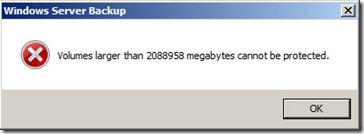
The not very helpful message you will receive if you try a full server backup when one of the volumes is too large is
“Volumes larger than 2088958 megabytes cannot be protected.”The work-around is to not do full volume backups, but make your selection of folders. Choose ‘Custom’ backup configuration and then just select all the folders on the volume that is too large.
The work-around is to not do full volume backups, but make your selection of folders. Choose ‘Custom’ backup configuration and then just select all the folders on the volume that is too large.
Configuring updates stage 3 of 3. 0% complete – SYSTEM RESTARTS [Windows Vista , win2008, win7]

First
make sure you are able to boot to the desktop.
You can try performing the Method 3 suggested in the article
( http://support.microsoft.com/kb/949358)
Try performing the following steps:
Start Windows Vista and go to the System Recovery options:
1.
Insert the Windows Vista installation disc in the disc drive, and then restart
the computer.
2. When you are prompted to restart from the disc, press any key.
3. When you are prompted, configure the Language to install, Time and currency
format, and Keyboard or input method options that you want, and then click
Next.
4. On the Install Windows page, click Repair your computer.
5. On the System Recovery Options page, click the version of the Windows Vista
operating system that you want to repair, and then click Next.
6. Use the System Recovery options to rename the Pending.xml file and edit the
registry:
7. On the System Recovery Options page, click Command Prompt.
8. Type cd C:\windows\winsxs, and then press ENTER.
9. Type ren pending.xml pending.old, and then press ENTER.
10. Type regedit, and then press ENTER.
11. Select HKEY_LOCAL_MACHINE.
12. On the File menu, click Load Hive.
13. Locate the following folder:
14. C:\windows\system32\config\components
15. When you are prompted for a name, type Offline_Components.
16. In Registry Editor, locate and then delete the following registry subkey:
17. HLKM\Offline Components\AdvancedInstallersNeedResolving
18. HKLM\Offline Components\PendingXmlIdentifier
19. Exit Registry Editor, At the command prompt, type exit to exit Registry
Editor. Press ENTER.Click Restart.
20. Once you are back on the desktop try performing windows updates and check
Windows update error code 80072ee6
1st try this
Click “Start”
Then Click “Run”
Copy and Paste this ” regsvr32 MSXML3.dll ”
Click “OK”
You should see a dialog box stating that the operation has suceeded.
Then open Messenger again and sign in.
If this doesn’t work then try to clear your DNS cache by:
Click “Start” then “Run” and type “cmd.exe”
Then type “ipconfig /flushdns”. You should get a message stating that the cache has been cleared.
if thats not working try this
edit the registry and find for this key ‘UseWUServer’ if the value is ‘1’ ). I changed it to ‘0’, rebooted, and Run Windows Update
The “Desktop Wallpaper” Group Policy setting is not applied in Windows 7 or in Windows Server 2008 R2
n an Active Directory domain network environment, you apply a “Desktop Wallpaper” Group Policy setting to the domain users. However, the setting is not applied to domain users who log on to client computers that are running Windows 7 or Windows Server 2008 R2.
This issue varies if the following conditions are true:
- If the domain user logs on the domain after you deploy the “Desktop Wallpaper” Group Policy setting, the desktop background changes to black.
Note The color of the desktop background varies, depending on the color scheme that you set. - If the domain user logs on the domain before you apply the “Desktop Wallpaper” Group Policy setting, the desktop background does not change.
Additionally, in the Personalization window of the client computer, the desktop background is displayed as being changed to the setting that you applied.
Hotfix Download Available
windows 7 / windows 2008 R2 x64
windows 7 / windows 2008 R2 x86
Tech Doc source
http://support.microsoft.com/kb/977944
Export Members List from Active Directory
Open a command prompt and enter
net group YourGroupName /domain >c:\memberslist.txt
(Do NOT replace /domain with your domain name.)
Download This Script File to export All AD users Group info
Export AD users group full list
After run check the file “groupdump.txt”
Install Windows from a USB drive!


Imagine a situation where you need to install Windows Vista or 7 in a system but you don’t have access to DVD drive. We all know Windows Vista, Server 2008 or 7 comes in DVDs and you’ll need a DVD drive to install them. Then how will you install them? The solution is, you can create a bootable USB drive which can be used to install Windows without using DVD drive.
Requirements:
* A USB Drive (4 GB or more)
* Windows Vista, Server 2008 or 7 ISO image or DVD
* Host OS: Windows Vista (SP1 or SP2), Server 2008 or 7
How to use:
Once you meet the requirements, run the utility. Its a portable utility so doesn’t need installation. Simply run it and check the option “I have read and accepted the following License Agreement”. Now click on OK button and it’ll launch the main application.
It also shows a Help window so that you can use the utility easily. The utility requires only 4 easy steps to follow:
* Check USB drive (To check whether your USB drive is attached or not)
* Format USB drive
* Choose DVD or ISO image (To copy the required files to USB drive)
* Start the process to create bootable USB drive
How to remove data in Active Directory after an unsuccessful domain controller demotion
DHCP server default permission settings in the registry
HKEY_LOCAL_MACHINE\SYSTEM\CurrentControlSet\Services\Tcpip “Local service” Full, Read (add this permission)
HKEY_LOCAL_MACHINE\SYSTEM\CurrentControlSet\Services\BFE “NT Service\BFE” Full, Read (add this permission)HKEY_LOCAL_MACHINE\SYSTEM\CurrentControlSet\Services\DPS “NT Service\Trustedinstaller” Full, Read (add this permission)
HKEY_LOCAL_MACHINE\SYSTEM\CurrentControlSet\Services\NlaSvc “NT Service\NlaSvc” Full, Read (add this permission)
HKEY_LOCAL_MACHINE\SYSTEM\CurrentControlSet\Services\SharedAccess\Epoch “NT Service\MpsSvc” Query, Set Value (add this permission)
HKEY_LOCAL_MACHINE\SYSTEM\CurrentControlSet\Services\SharedAccess\Parameters\FirewallPolicy “NT Service\MpsSvc” Full, Read (add this permission)
HKEY_LOCAL_MACHINE\SYSTEM\CurrentControlSet\Services\SharedAccess\Defaults\FirewallPolicy “NT Service\MpsSvc” Full, Read (add this permission)
server manager encountered an unexpected error while collecting data about the stutus of HRESULT:0x80070543
server manager encountered an unexpected error while collecting data about the stutus of this computer
HRESULT:0x80070543
Problem:
The server-wide COM security settings have been changed to have a “Default Authentication Level” of ‘None.’
Solution:
1. Using elevated permissions, run Dcomcnfg.exe
2. In the “Component Services” window, navigate to ComponentServices->Computers->My Computer.
3. Right-click on “My Computer” and select [Properties] from the context menu.
4. In the “My Computer Properties” dialog, select the [Default Properties] tab.
5. Change the “Default Authentication Level” drop to ‘Connect’; if it is set to None.
7. Change the “Default Impersonation Level” to Identify; if it is set to something else.
8. Press the OK button in the “My Computer Properties” dialog.