Category Archives: Windows 8.1

Update Windows Defender even when Automatic Windows Updates is disabled in Windows 8/10

Windows Defender will not update its definitions, if Windows Updates is not set to Install updates automatically in Windows 10/8. If for some reason you have changed your settings and preferred to set any of the other three updating’s options, viz. Download updates but let me choose whether to install them, Check for updates but let me choose whether to download and install them or Never check for updates, your Windows Defender will not have the latest definitions, till such a time that you update them manually. This is because, Windows Defender and Windows Update in Windows 8 are  both dependent on the Windows Updates services.

This is not a recommended scenario, as one’s security software should be updated as soon as new definitions are available for download.

Update Windows Defender when Automatic Windows Updates is disabled

But you can set it so that Windows Defender will check for, download and install updates as soon as they are available, even if you have disabled Automatic Windows Updates.

To do so, open the Task Scheduler. You will find it under Administrative Tools in your Control Panel.

task-scheduler-1

In the right pane, click on Create Basic Task. The Create Basic Task Wizard will open. Give the task a name and description and click on Next.

ts-2

Select the frequency, viz Daily.

ts-3

Set the Time at which the updating task should run.

ts-4

Next select Start a program.

ts-5

Advt

^

In the Program box, type “C:\Program Files\Windows Defender\MpCmdRun.exe”. MpCmdRun.exe is the executable file of Windows Defender that helps in carrying out common tasks like scanning, scheduling, updating, etc.

In the Add arguments box, type -SignatureUpdate. This is one of the available command line arguments for Windows Defender.

ts-6

Having done this, review the details and click on Finish.

ts-7

You will now be able to see the task in the Task Scheduler Library.

Now your Windows Defender will update itself, regularly, every day at the set time, although you may have disabled Automatic Windows Updates.

If you want Windows Defender to check for signature updates more than once every day, you will have to additionally do the following:

Open its Properties box and click on Triggers tab. Select the task and click on Edit.

def-props

Here check the Repeat task every and from the drop-down menu, select 1 hour. This will check for updates every hour. If you wish to check every 6 hours, simply change the figure from 1 to 6; it works!

edit-trigger

Click OK/Apply and Exit.

When the task is run, a black CMD window will open momentarily and close down.

If you wish to run a silent update, instead of: C:\Program Files\Windows Defender\MpCmdRun.exe –SignatureUpdate you may use: C:\Program Files\Windows Defender\MSASCui.exe -Update.

Let us know how this works for you.

(Credits to http://www.thewindowsclub.com/update-windows-defender-automatic-windows-updates-disabled )
Analyze and clean the WinSXS folder

Please note that the commands will only work on Windows 8 or newer machines.

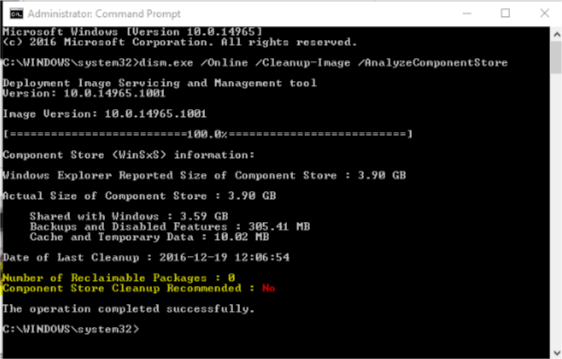
Here is what you need to do to analyze the WinSXS Folder:

  1. Tap on the Windows-key, type cmd.exe, hold down Shift and Ctrl, and hit the enter key on the keyboard. This opens an elevated command prompt on the system.
  2. Run the command dism.exe /Online /Cleanup-Image /AnalyzeComponentStore
  3. ceanup

The parameter /Online refers to the current installation, and /Cleanup-Image /AnaylzeComponentStore to analyzing the current component store of that installation (the WinSXS folder).


You can list all available commands using dism.exe /?, and subsequently dism.exe /Online /? and dism.exe /Online /Cleanup-Image /?.

The command runs a scan that takes a moment to complete. It echoes the Windows Explorer size and actual size to the command prompt window, and gives recommendations whether it makes sense to run a cleanup operation.

Cleanup

Windows runs a cleanup regularly using the Task Scheduler. You can check if that is the case on your machine in the following way:

  1. Tap on the Windows-key, type Task Scheduler and hit enter.
  2. Navigate to Task Scheduler (local) > Task Scheduler Library > Microsoft > Windows > Servicing > StartComponentCleanup

You can run the cleanup operation manually at any time using the following command using an elevated command prompt:

dism.exe /Online /Cleanup-Image /StartComponentCleanup

or for more

dism.exe /Online /Cleanup-Image /StartComponentCleanup /ResetBase


For service pack cleanup

dism.exe /Online /Cleanup-Image /spsuperseded /hidesp


How to setup BitLocker Encryption on Windows 8 / 8.1 without TPM

BitLocker is a full disk encryption software that comes standard with PCs running Windows 8 Pro or higher.

BitLocker_Logo_e546caa310

This document provides instructions for encrypting the hard drive without Trusted Platform Module (TPM – integrated security chip) present or enabled, and bypasses the USB flash drive encryption key requirement.

  1. From the Metro UI or the search box, type GPEDIT.MSC and press enter
  2. Open Computer Configuration =>
    Administrative Templates =>
    Windows Components =>
    BitLocker Drive Encryption =>
    Operating System Drives. From the right pane double-click “Require additional authentication at startup” and select “Enabled” and apply it. then run “gpupdate” from a command line.

Now you can enable Bitlocker without TPM


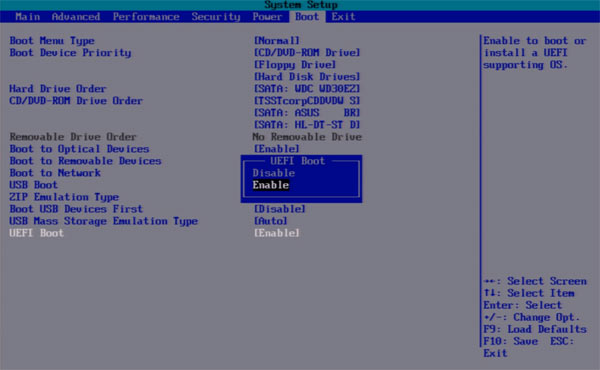
How to install windows 8 in a UEFI environment with Secure boot enabled

UEFI-Boot

If you want to install a clean copy of Windows 8 or Windows 8.1 on a UEFI enabled computer, you will need a UEFI bootable USB flash drive to start with. This is a tutorial to show you how to make such flash drive with and without the help of 3rd party tool.

The manual process

1. Connect the USB flash drive to your computer, of course.

2. Open Command Prompt with Admin rights. Press Win+X and choose Command Prompt (Admin) from the list.

3. Type diskpart to start the diskpart built-in utility. And type list disk and make the note of the disk # for the USB drive.

4. Type in the following command to properly format the flash drive. Replace # with the actual # you got from step 3 above.

select disk #
clean
create partition primary
format fs=fat32 quick
active
assign
exit

5. Now close the Command Prompt window, and open File Explorer, browser through to the location where saves the Windows 8 installation ISO image file.

6. Mount ISO file by right-clicking the ISO file and choosing Mount. If you don’t see Mount command from the context menu, go to Open With → Windows Explorer instead.

7. Select everything in the ISO file, and copy them into the formatted USB flash drive you prepared earlier

8. One more extra step if you are preparing for a 64-bit version of installation. You will need to copy a file called bootmgfw.efi from inside install.wim file at sources folder to efi\boot folder on USB flash drive, and rename it to bootx64.efi. Sounds tedious, isn’t it? So let’s put an easy way, you can simply download this file (direct download link) and copy to your efi\boot folder.

That’s it. Now, you can boot off from this USB flash drive and start the fresh clean installation.


How to Find the Wi-Fi Password Using CMD in Windows?

Finding Wi-Fi Password

Step1: Press start and type CMD, right-click on the Command Prompt option shown as a search result and click on Run as administrator.  

Step 2: Type netsh wlan show profile in the command prompt and press Enter to show a list of network names that we connect to.

Step 3: Type netsh wlan show profile name= “Wi-Fi name” key=clear, Replace ‘Wi-Fi name’ with your wireless network name.

Step 4: Scroll through the results until you find an entry named Key Content Wi-Fi password will be listed next to it.