Category Archives: Server 2016

All Users Desktop Folder in Windows Server 2016/2019

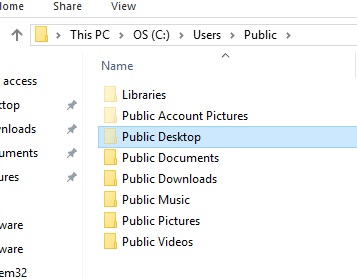
If you want to copy some shortcuts or files to all users desktop in server 2016/2019. specially if your configuring a remote desktop session host server and you want to copy company applications short cuts to all users desktop.like in previous versions c:\users\all users\desktop is not available on these server editions.

in Server 2019 and 2016 its available in

C:\Users\Public\Desktop


If you cannot see the desktop Folder tick show hidden items from windows explorer ribbon 

Also

To find out the directory for your system run Following command in a PowerShell prompt:

[Environment]::GetFolderPath('CommonDesktopDirectory')

Create a USB Drive for Windows Server 2016 Installation For UEFI Systems


The at least a 8GB USB drive has to be formatted in FAT32
The USB needs to be GPT and not MBR
Copy all files from the ISO to the USB drive

This is it, and here is how you do it:

First plugin your USB drive to your computer. The USB drive should be bigger than 6GB.

Open a CMD prompt or PowerShell using the Run as Administrator option and open diskpart. Now you can do list all this by using

list disk

Select the USB disk, in my case this was disk 1

select disk 1 (Be careful Select the correct Disk)

Clean the disk. Be careful this will remove all files and partitions on the USB media.

clean

Now convert it to GPT

convert gpt

Create a new primary partition. But make sure the partition is not greater than 16GB otherwise it can be formatted with FAT32.

create partition primary

# If your USB drive is bigger than 16GB use the following command

create partition primary size=16000

Format the partition with FAT32

format fs=FAT32 quick

Assign a drive letter to the volume

assign letter=k

now you can exit the diskpart and copy all files from the Windows or Windows Server to the USB drive and boot it. This works with Windows 8, Windows 8.1, Windows 10, Windows Server 2012, Windows Server 2012 R2 and Windows Server 2016 or even Hyper-V Server in the same editions.

Important:

If Install.wim is larger than 4GB, you cannot copy the file to the drive, because of theFAT32 based partition limitation. The solutions for this is to split the wim file into smaller files.

split wim file using dism (you may have to change the drive letters):
dism /Split-Image /ImageFile:e:\sources\install.wim /SWMFile:k:\sources\install.swm /FileSize:4096
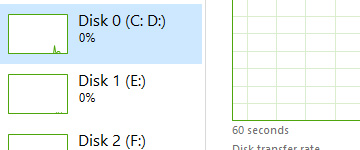
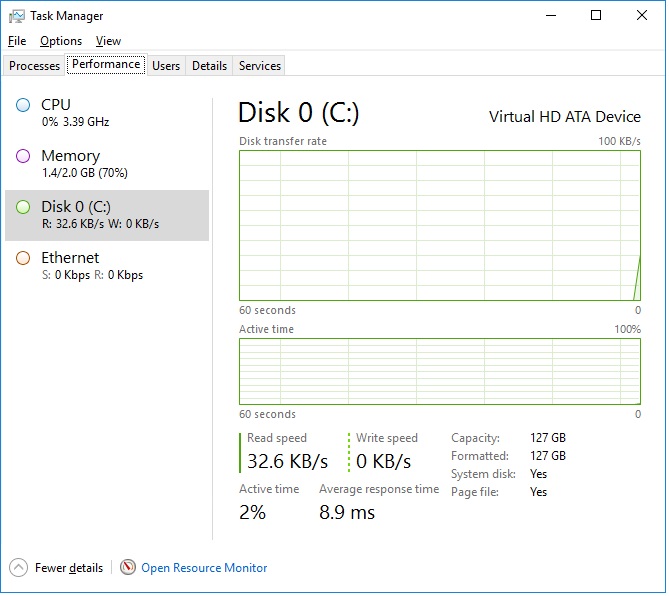
Enabling Disk Performance Counters in Windows Server 2016 Task Manager


In Windows Server 2012 R2 / 2016, disk performance counters were disabled by default because of a noted significant performance impact in collecting Disk metrics on a Server. This is due to the overhead Task Manager can cause when querying each Disk IO for each process/thread on the individual disk. Interestingly enough disk resource values are visible in the Processes view of Task Manager found on Windows 8.1.  Not to fret though, as enabling disk performance counters in Windows Server 2012 R2 / 2016  is far from being a daunting task.

Step 1: Enabling Disk Performance Counters

  1. Ensure Task Manager is closed.
  2. Launch the Command Prompt using the “Run as Administrator” option.
  3. Enter the following at the Command Prompt:diskperf -Y
  4.  Hit Enter.
  5. Close the Command Prompt.
  6. Re-open the Task Manager.

After running the diskperf command, the ability to view Disk performance statistics on the performance tab should now be visible.


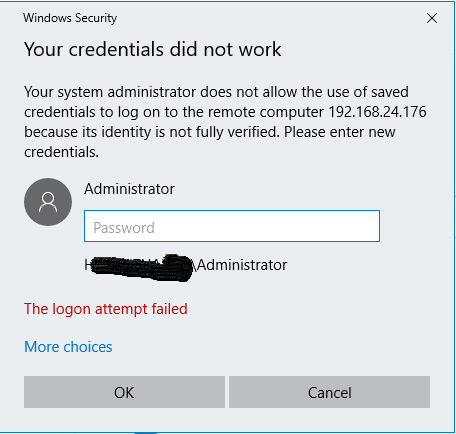
Your system administrator does not allow the use of saved credentials to log on to the remote computer

M2

If you’re a system administrator working with remote desktop a lot within a somewhat restrictive domain environment, you may be frustrated by the following message:

There are a few tutorials on the net that say to remove this you just need to go into Group Policy and disable ‘Do not allow passwords to be saved’, unfortunately that isn’t what this error message is related to. Instead, we need to change another part of Group Policy.

Hit Win+R to bring up the ‘Run’ dialog, enter ‘gpedit.msc’ and hit OK.

Run dialog with gpedit.msc

Go down the tree into Computer Configuration -> Administrative Templates -> System -> Credentials Delegation.

Group Policy -> Credentials Delegation

Now, you need to allow Allow delegating saved credentials and Allow delegating saved credentials with NTLM-only server authentication. For each, you’ll also need to allow a set list of servers that are explicitely allowed to save credentials, you can enter IP Addresses, Server hostnames, AD Domain name wildcards, or just any old wildcard. Since I wanted to be able to store credentials for everything, I just used a plain wildcard, and you can too!

Allow Delegating Saved Credentials with Wildcard

There we go, you’ll now automatically connect to your servers!

( source – http://rudiv.se/Article/fix-for-system-administrator-not-allow-saved-credentials-rdp )