How to Enable Standard Journaling – Exchange 2000

It is recommended that you designate a dedicated Exchange server as the journaling server. Additionally, if you use a dedicated journaling server, you do not have to enable standard journaling on the server. Enable journaling only on those servers with mailbox stores for which you want to journal.

Before You Begin

Review your overall journaling strategy to verify that journaling is enabled on appropriate Exchange server.

To enable standard journaling

  1. In Exchange System Manager, expand Servers, expand <your Exchange server>, expand <storage group>, and then right-click the mailbox store.
  2. On the General tab, select Archive all messages sent or received by mailboxes on this store, and then click Browse to specify a mailbox as the journaling mailbox. All journalized messages for senders on this mailbox store are sent to the mailbox you specify.

Virus.Win32.Sality.aa Removal

Can’t delete Virus.Win32.Sality.aa? Win32.Sality.aa better referred as Virus.Win32.Sality.aa or virus Sality is a virus that can download adware, spyware and other malware threats and generates corrupt files in Windos Win directories. After infecting the system virus Virus.Win32.Sality.aa will trigger diverse malware infections and install corrupt scvhsot.exe, blastclnnn.exe, blastclnnn.exe, hinhem.scr files causing unreliable system speed. Usually, the Virus.Win32.Sality.aa is installed after clicking on unsolicited spam e-mail links, corrupt p2p and freeware downloads or via porn related web sites. The Virus.Win32.Sality.aa is a disruptive virus utility that can send credit card numbers, passwords and oth er sensitive information to distant servers.

Automated Virus.Win32.Sality.aa Removal
(Windows 98, ME, 2000 or XP)
Windows Vista VersionClick Here

Kasperskey Tool to remove Sality

http://support.kaspersky.com/downloads/utils/sality_off.rar

Full instructions at

Open IE’s Private Browsing Mode the Easy Way

Internet Explorer’s “private browsing” mode is an excellent way to hide what you’re looking at from prying eyes, but it’s normally hidden under a menu… but we can make it easier to access.

The Normal Way

To open an InPrivate Browsing window, you can either use the Ctrl+Shift+P shortcut key, or just use the Safety \ InPrivate Browsing item on the menu.

image

And you’ll immediately see a private browsing window, which will leave no traces of your browsing history. Useful!

image

The other thing that private browsing is useful for is checking your email on somebody else’s computer – no danger of cookies lying around letting them back into your email account once you’ve gone.

Windows 7 Makes it Really Simple

If you are using Windows 7, all you have to do is right-click on the icon in the taskbar and choose the InPrivate option. You can also click and hold the left mouse button on the icon, and slide your mouse up… the menu will pop up and you can choose it there.

image 

In other news, Windows 7 is really, really slick. If you haven’t already, check out our coverage of the beta release.

Create a Shortcut to Open Private Browsing Mode

If you haven’t made the switch to Windows 7 yet, you can still create your own shortcut manually. Simply create a new shortcut to Internet Explorer, and add the following to the end (after the quotes).

-private

The final path should look similar to this, depending on your system:

image

Give the icon a useful name indicating that it’s a private mode shortcut…

image

And now you have a shiny new icon to start up Internet Explorer in private browsing mode.

Work Faster with new Windows 7 Short cuts keys

Windows 7 beta 1 includes some handy new shortcut key combinations that allow you to navigate and manage the Windows workspace more efficiently. Here are 10 new Windows 7 shortcuts that will help you speed up your workflow (“Win” means the Windows Key):
Win+Home: Clear all but the active window
Win+Space: All windows become transparent so you can see through to the desktop
Win+Up arrow: Maximize the active window
Win+Down arrow: Minimize the active window or restore the window if it’s maximized
Win+Left/Right arrows: Dock the active window to each side of the monitor
Win+Shift+Left/Right arrows: If you’ve got dual monitors, this will move the active window to the adjacent monitor
Win+T: Shift focus to and scroll through items on the taskbar
Win+P: Adjust presentation settings for your display
Win+(+/-): Zoom in/out
Shift+Click a taskbar item: Open a new instance of that particular application

Windows 7 System Maintenance Tool

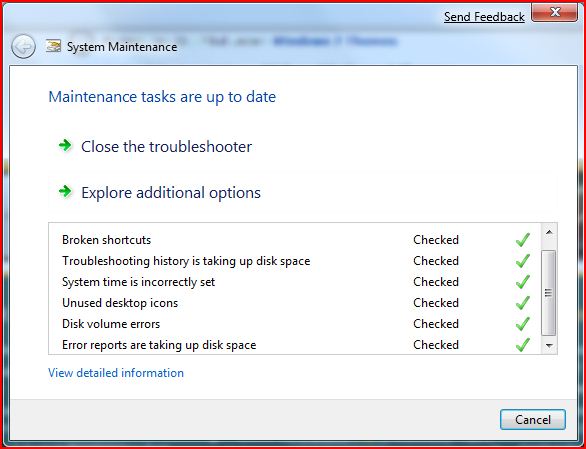
With Windows 7 Microsoft introduces a system maintenance tool. You are curious what it is doing, right?

It checks for:
– Broken shortcuts
– Unused desktop icons
Update:
– Troubleshooting history / Error reports taking up disk space
– System Timecorrection
– Disk Volume errors
 

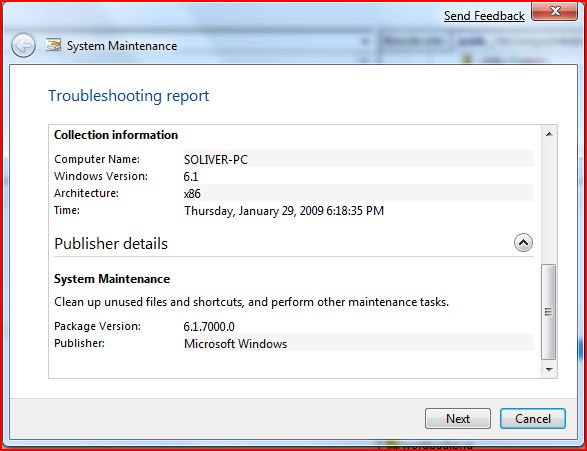
And also collects system information:


Random Info: I took both screens with the new Windows 7 snipping tool, which will increase your productivity a lot. What I don’t like about it is the red border and it saves the file extension in uppercase-letters if you do not type them in.

Anyway, I think Microsoft should deliver all the tools we know from TuneUpUtilites. I do not want to buy additional software to do all the tweaks that are hidden in the registry.

They should include:

– Optimize performance / disable certain graphic elements

– Registry cleaner

– Cookie / Temp cleaner

– Clear History / Favorites / etc

– Advanced Defrag

What else would you like in there  if you could change the system maintenance tool ?

Update:

This is the latest system maintenance tool:

Find All Locked Out Accounts

Use Saved Queries to quickly locate all locked out user accounts.

You can use the Saved Queries feature of Windows Server 2003 to query Active Directory for any locked-out accounts. Just open the Active Directory Users and Computers console, right-click on Saved Queries in the console tree and select New –> Query. Type a name and description for the query, specify a query root (where in your namespace your query begins searching), and click the Define Query button. Since there’s no default option for finding locked-out accounts in the Common Queries box, select Custom Search instead to open the Find Custom Search box. Then select the Advanced tab and enter the following LDAP string in the Enter LDAP Query textbox:


(&(&(&(objectCategory=person)(objectClass=user)(lockoutTime:1.2.840.113556.1.4.804:=4294967295))))


Click OK twice to create and run the saved query.


The string works on Windows Server 2003 SP1.


Update: Here’s another LDAP query that finds all locked out accounts:
 
(&(objectCategory=Person)(objectClass=User)(lockoutTime>=1))

BitLocker To Go Encrypts Portable Flash Drives in Windows 7

The BitLocker feature was introduced in Windows Vista and allowed you to encrypt the content of your hard drive.  Now in Windows 7 they offer BitLocker To Go which allows you to encrypt portable USB flash drives.

First open up My Computer and Right-click on the flash drive you want to encrypt and select Turn on BitLocker.

1

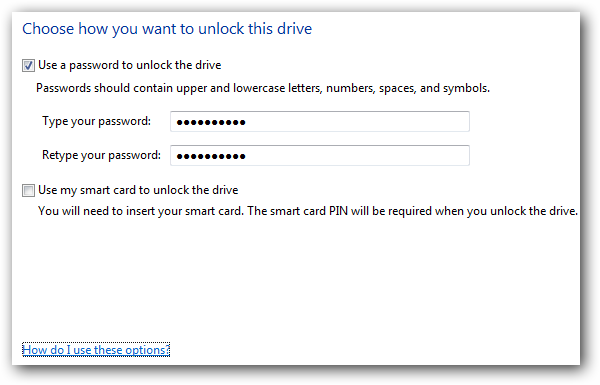
After BitLocker initialized the flash drive you will need to enter in a password to unlock the drive.  You can also set up a Smartcard which are usually used in a work environment so talk to you IT staff.

2 pw

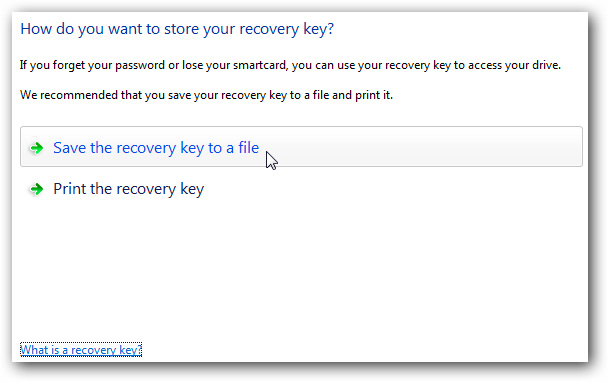
Next you will be prompted to store the recovery key which is used in the event you lose your password or smartcard.  If you store it as a file make sure that it is not on the same drive that you’re encrypting.  

3 key

After the key has been saved as a file or printed you will see a confirmation message.

4 save confirm

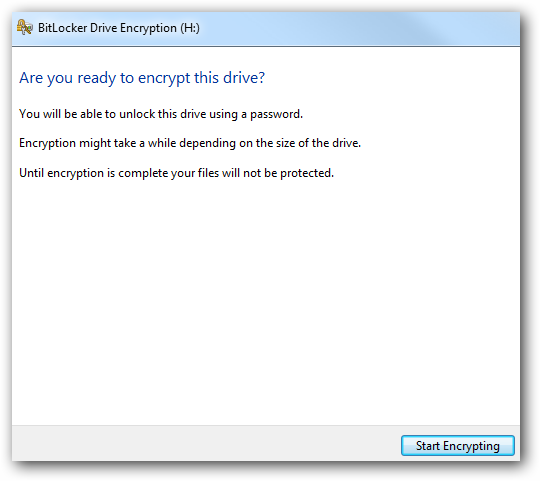
Finally you will be ready to start encrypting the drive so just click the Start Encrypting button.

5 confirm

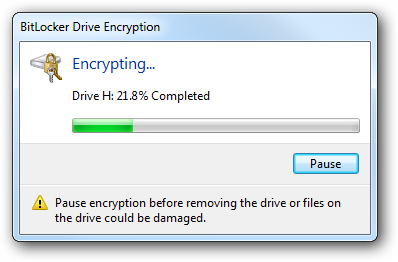
While it is encrypting there will be a progress screen displayed.

6 progress

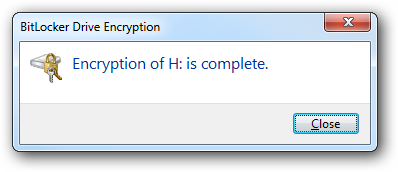
A successful encryption of the USB flash drive. notice that the drive icon will change to show its encrypted with BitLocker.

7 complete 

Notice that the drive icon will change to show its encrypted with BitLocker where the gold lock indicates it is locked up and the gray lock is displayed after you have unlocked it.

 8 iconunlock

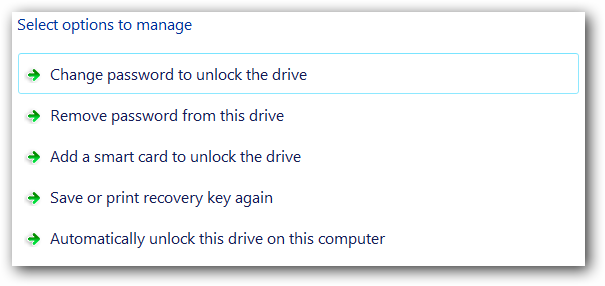
Right-click on that icon to bring up options to manage BitLocker encryption.

9 options

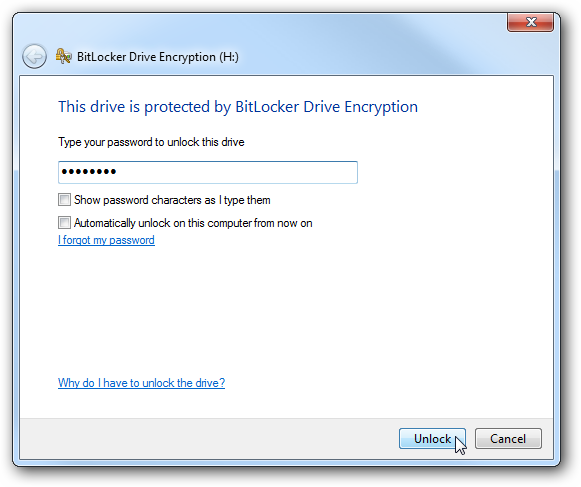
The next time you plug in the drive to a Windows 7 machine you will be prompted to enter the password to gain access to the drive.  You can also always have it unlocked on specific machines in the future.

enter 

You can also use the encrypted drive in Vista and XP.  Here we will look at how it looks in XP, when you plug it in you will be prompted for the password to launch BitLocker To Go Reader (the utility is installed automatically on the drive by Windows 7).

bitlocker XP

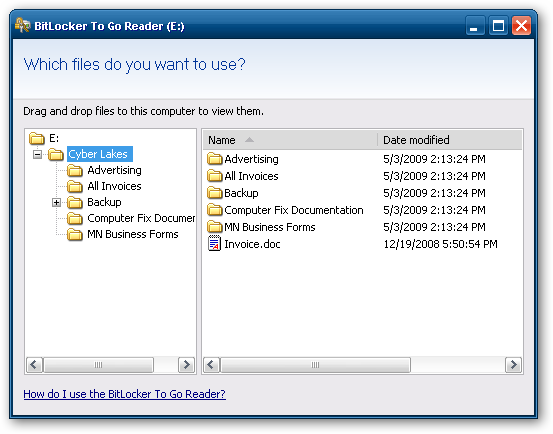
BitLocker To Go Reader is a Windows Explorer type navigation utility for showing the content of the drive.

bitlocker reading

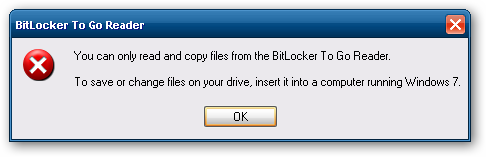
With a BitLocker encrypted drive you will only be able to read and copy files.  If you need to add files or change them you will need to use a Windows 7 machine.

error

This is a great way to easily make sure sensitive data on your USB flash drive is safe.  Right now anyone who has Windows 7 RC1 Ultimate can use this feature.