Kapothi Tech Blog

AntiVirus

How do I configure a Mirror server using ESET Smart Security Business Edition or ESET NOD32 Antivirus Business Edition?

by neyomax on Jul.21, 2010, under AntiVirus

Configuring an ESET client solution as a local Mirror Server

ESET Smart Security Business Edition and ESET NOD32 Antivirus Business Edition client solutions can be configured to store copies of virus signature update files, much like a standard Mirror server. These virus signature files can then be used to update other workstations that are running ESET Smart Security or ESET NOD32 Antivirus. A version 4.x or version 3.0 ESET client solution that is configured as a Mirror server cannot be used to update ESET NOD32 Antivirus 2.7 clients.

To configure an ESET client solution as a Mirror server, perform the following steps:

  • Open the main program window by clicking the ESET icon  next to your system clock or by clicking Start → All Programs → ESET → ESET Smart Security or ESET NOD32 Antivirus.
     
  • Press the F5 key to display the Advanced Setup window (enter a password if the client is password-protected).
     
  • From the Advanced Setup tree, click Miscellaneous → Licenses and click Add…. Navigate to your license file (nod32.lic) and click Open then click OK.
  • Press the F5 key to display the Advanced Setup window. From the Advanced Setup tree, click Update and enter the license information supplied by ESET in the Username and Password fields. Make sure the Update server: drop-down is set to Choose Automatically.

  • Click the Setup… button next to Advanced update setup: and click the Mirror tab.
     
  • From this point you can configure the Mirror to provide updates via an internal HTTP server, or via a shared network folder. To provide updates via an internal HTTP server, perform the following steps directly below (to provide updates via a shared network folder, click here):

    1. Select the Create update mirror and Provide update files via internal HTTP server check boxes.
       
    2. In the Folder to store mirrored files: field, enter the directory path to the folder that will contain the update files. Do not enter values in the Username and Password fields.
       
    3. If you wish to use a port other than the default port (2221), click the Advanced setup button and enter the value in the Server port: check box (the default value is recommended unless you have other applications communicating on this port).

  • Click OK three times to save the settings and return to the main program window.
  • To configure the Mirror to provide updates via a shared network folder, perform the steps directly below after clicking the Setup… button in step 5.

    1. Created a shared folder on a local or network device. This folder must be readable by all users running ESET software, and writeable by the local SYSTEM account (If the shared folder is located on another computer in the network, it is necessary to specify authentication for accessing that computer. Click here for additional information).
       
    2. Select the Create update mirror check box. Do not select the Provide update files via internal HTTP server check box.
       
    3. Enter the name of the shared folder (created in step 1) in the format \\UNC\PATH.

  • Click OK twice to save the settings and return to the main program window.
     
  • For detailed instructions on installing ESET Remote Administrator and configuring a standard Mirror server, click here.

    If you are looking for instructions on configuring an ESET client solution to access a Mirror server for virus signature and program component updates, please see sections 3.2 and 5.1 in the ESET Remote Administrator Guide.

    Leave a Comment more...

    How to Change Licence key Kaspersky 6

    by neyomax on Jun.16, 2010, under AntiVirus

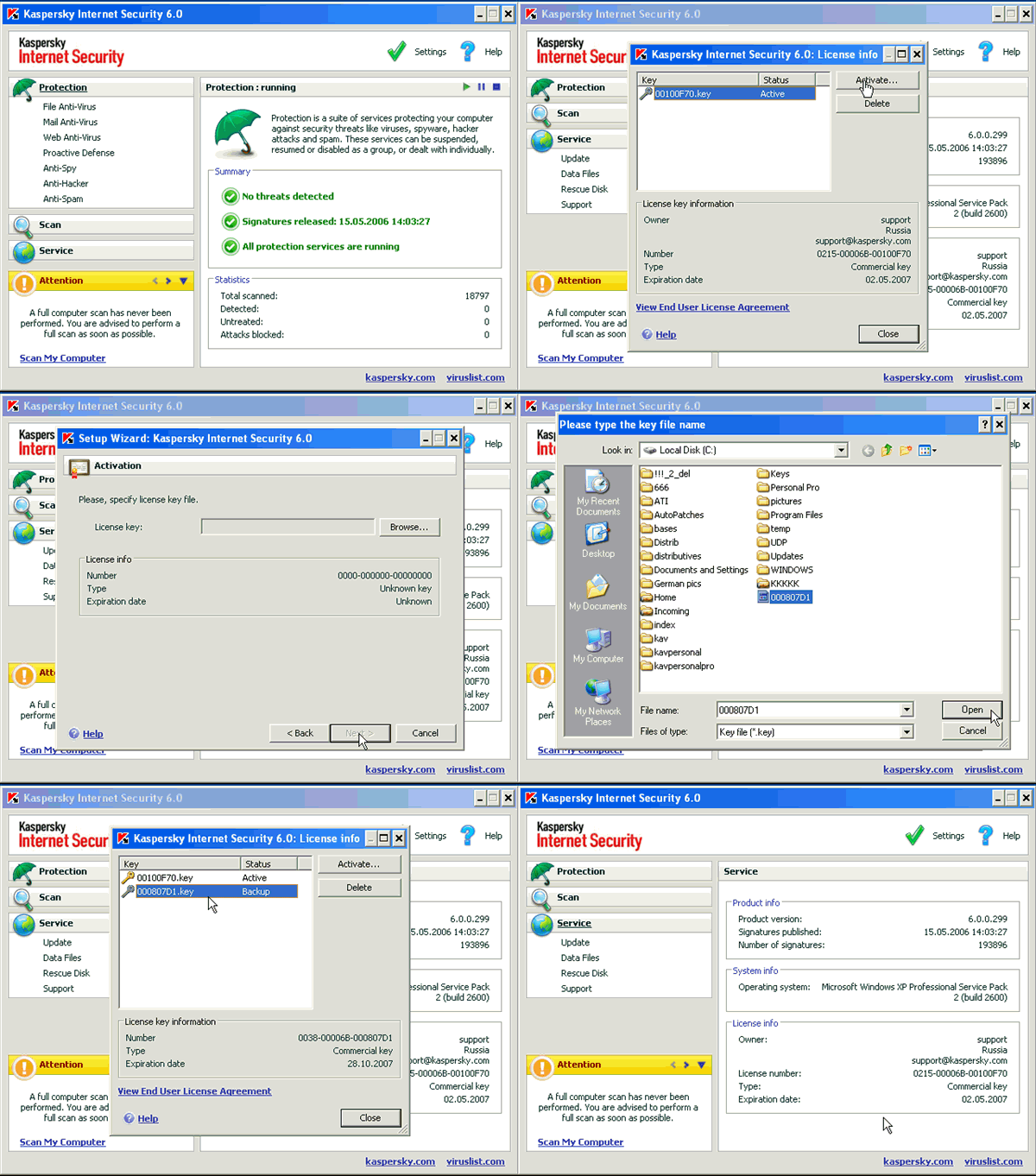
      How to install a new key file: 

    • open Kaspersky Anti-Virus 6.0 or Kaspersky Internet Security 6.0 main application window 
    • go to the Service tab
    • left-click the License Info section
    • in the open window click the Activate button 
    • in the Setup Wizard window select Apply existing license key 
    • click Next

    Note: if the currently used key file for Kaspersky Anti-Virus 6.0 or Kaspersky Internet Security 6.0 is still valid, the corresponding warning window will be displayed. 

    • in the Activation window click the Browse button 
    • select the folder in which you unpacked the contents of the received archive with the key file/ saved the key file 
    • double-click the key file 
    • see the information about the added key file and click Next 
    • in the last Activation window click Finish 
    • close the window with the info about the used license keys 
    • minimize the main window of Kaspersky Anti-Virus 6.0 or Kaspersky Internet Security 6.0

    Note: the dialog windows in the article are given for Kaspersky Internet Security 6.0. The dialog windows for Kaspersky Anti-Virus 6.0 product are the same, but for the name of the product.

    onlineactivation3

    Leave a Comment more...

    Eset Standalone malware removal tools

    by neyomax on Dec.19, 2009, under AntiVirus

    servers_tabs[1]
    ESET security products automatically identify and clean the majority of infected files. Occationally, infiltrations require a special removal tool to completely clean the system. ESET provides tools to remove particularly resilient threats, including rogue antivirus programs and malware.

    If you are experiencing trouble removing one of the following viruses, you can download the relevant malware removal tool from below link :

    http://kb.eset.com/esetkb/index?page=content&id=SOLN2372&actp=LIST_RECENT

    Leave a Comment more...

    My ESET firewall is blocking the HomeGroup feature in Windows 7. How do I fix it?

    by neyomax on Nov.06, 2009, under AntiVirus

    If the Windows 7 HomeGroup feature is having difficulty connecting to other users, your ESET Smart Security Perasonal firewall may be blocking the connection. To allow HomeGroup connectivity, you will need to create rules on every computer protected by the ESET Smart Security firewall on the network.

    1. Open the main program window by clicking the ESET icon  next to the system clock or by clicking Start → All Programs → ESET → ESET Smart Security.
    2. If you see Display: Standard mode in the lower left corner, switch to Advanced mode by clicking Change… or by pressing CTRL + M on your keyboard.
    3. Click Setup → Personal firewall in the main menu on the left and then click Switch to interactive filtering mode in the Personal firewall area.                                                                                                                                                      
    4. Attempt to connect to other computers in your HomeGroup. Your ESET Personal firewall will prompt you to allow or deny each connection that is not defined by an existing rule. To create the rules you need, select the Remember action (create rule) option in the dialog window.

    .

    When you have created the rules you need, set the Personal firewall to Automatic mode with exceptions: While in the Advanced mode display, click Setup → Personal firewall (see steps 1-3) and then click Switch to automatic filtering mode with exceptions

    The Personal firewall will now function as it would in Automatic mode, while maintaining the specific exceptions (rules) that you defined for problematic applications in Interactive mode. For advanced troubleshooting information on blocked connections in the Personal firewall, click here.

    Leave a Comment more...

    How do I reset the ESET Remote Administrator Console password? (3.1.11)

    by neyomax on Oct.26, 2009, under AntiVirus

    KB Solution ID: SOLN741|Last Revised: October 01, 2009

    ESET Remote Administrator (ERA) should be installed on a computer which is accessible by system or network administrators only. The information in this article is intended for such users.

    The ESET Remote Administrator Console (ERAC) password is used to prevent unauthorized changes to the ESET Remote Administrator Server (ERAS) settings. By default, this password is blank (If no password has been created, leave the Password field blank and click OK when prompted). However, if a previously created password has been lost or forgotten, the password can be reset. Please follow the steps below to remove the ERAC password:


    NOTE: Confirm that you can see hidden files and folders by  clicking Start → Control Panel → Appearance and Personalizations → Show hidden files and folders under Folder Options and select the Show hidden files and folders option. 

    Windows XP:

    1. Click Start Run and type:

      C:\Documents and Settings\All Users\Application Data\ESET\ESET Remote Administrator\Server\configuration
       

    2. Click OK. Right-click the era_private.xml file and choose Open With Wordpad. 


    3. Remove the entire line containing ‘ps_password_hash_con’. Close and save the file.


  • Restart the ESET Remote Administrator Server service.
     
  • You will now be able to open ERAC without entering a password (When prompted for a password, leave it blank and click OK).
  • Windows Vista:

    1. Click Start Run and type:

      C:\Program Data\ESET\ESET Remote Administrator\Server\configuration
       

    2. Click OK. Right-click the era_private.xml file and choose Open With Wordpad.

    3. Remove the entire line containing ‘ps_password_hash_con’. Close and save the file.
       
    4. Restart the ESET Remote Administrator Server service.
       
    5. You will now be able to open ERAC without entering a password (When prompted for a password, leave it blank and click OK).

    NOTE: If you wish to set a new password for ERAC, click Tools → Server Options, and click the Security tab. Click the Change… button to the right of Password for Console.

    Leave a Comment more...

    Looking for something?

    Use the form below to search the site:

    Still not finding what you're looking for? Drop a comment on a post or contact us so we can take care of it!