Open Registry editor
Navigate to :
HKEY-CURRENTUSER-> Software -> Microsoft -> Windows -> Current Version -> Internet Settings -> Zones -> Delete folder other than 0,1,2,3,4
Open Registry editor
Navigate to :
HKEY-CURRENTUSER-> Software -> Microsoft -> Windows -> Current Version -> Internet Settings -> Zones -> Delete folder other than 0,1,2,3,4

 thanks to a new Windows 7 feature called Virtual Wi-Fi.
The idea is a simple one: the operating system can virtualise any compatible wireless adapter, to make it appear as though you’ve as many additional adapters as you need.
The effect is dramatic. Once it’s set up, then any Wi-Fi compatible device that can connect to you – another desktop, laptop, or an iPod Touch, say – will immediately be able to get online, by sharing your internet connection through a duplicate of your wireless adapter.
Getting this working isn’t too difficult, either, as long as you can get over the first hurdle: finding a virtual Wi-Fi-compatible driver for your wireless adapter.
Intel’s latest 32-bit and 64-bit drivers now include support, as do various others for Atheros, Broadcom, Realtek and other big players, but these don’t apply to every chipset. Check the support site for your wireless adapter to see what’s available.
If you’re in luck and manage to find and install an up-to-date Windows 7 driver for your adapter, then the next step is to set it up, and for that you’ll need an elevated command prompt. Click Start, type CMD, right-click the Cmd.exe link and select “Run as Administrator”.
Now type the following command:
netsh wlan set hostednetwork mode=allow ssid=MyNet key=MyPassword
and press [Enter]. Replace “MyNet” with the name you’d like to use for your custom network, and “MyPassword” with a password that’s a little harder to guess.
Still at the command line, type
netsh wlan start hostednetwork
and press [Enter] to fire up the virtual adapter.
Now click Control Panel > Network and Internet > Network and Sharing Centre > Change Adapter Settings, right-click your internet connection and select Properties. Click the Sharing tab, check “Allow other network users to connect…”, choose your virtual Wi-Fi adaptor – and that’s it.
Any nearby Wi-Fi enabled device should see a new network appear with the SSID you defined above. They’ll be able to connect to it using your password, and can then immediately share your internet connection
Requirements
Step 1
Restart Windows 2003 in Directory Service Restore Mode.
Note: At startup, press F8 and choose Directory Service Restore Mode. It disables Active Directory. When the login screen appears, log on as Local Administrator. You now have full access to the computer resources, but you cannot make any changes to Active Directory.
Step 2
You are now going to install SRVANY. This utility can virtually run any programs as a service. The interesting point is that the program will have SYSTEM privileges (LSA) (as it inherits the SRVANY security descriptor), i.e. it will have full access on the system. That is more than enough to reset a Domain Admin password. You will configure SRVANY to start the command prompt (which will run the ‘net user’ command).
Copy SRVANY and INSTSRV to a temporary folder, mine is called D:\temp. Copy cmd.exe to this folder too (cmd.exe is the command prompt, usually located at %WINDIR%\System32).
Start a command prompt, point to d:\temp (or whatever you call it), and type:
instsrv PassRecovery “d:\temp\srvany.exe”
(change the path to suit your own).
It is now time to configure SRVANY.
Start Regedit, and navigate to
HKEY_LOCAL_MACHINE\System\CurrentControlSet\Services\PassRecovery
Create a new subkey called Parameters and add two new values:
name: Application
type: REG_SZ (string)
value: d:\temp\cmd.exe
name: AppParameters
type: REG_SZ (string)
value: /k net user administrator 123456 /domain
Replace 123456 with the password you want. Keep in my mind that the default domain policy require complex passwords (including digits, respecting a minimal length etc) so unless you’ve changed the default domain policy use a complex password such as P@ssw0rd
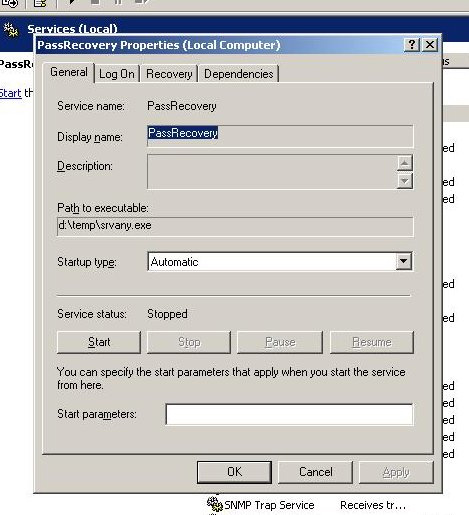
Now open the Services applet (Control Panel\Administrative Tools\Services) and open the PassRecovery property tab. Check the starting mode is set to Automatic.
Go to the Log On tab and enable the option Allow service to interact with the desktop.
Restart Windows normally, SRVANY will run the NET USER command and reset the domain admin password.
Step 3
Log on with the Administrator’s account and the password you’ve set in step #2.
Use this command prompt to uninstall SRVANY (do not forget to do it!) by typing:
net stop PassRecovery
sc delete PassRecovery
Now delete d:\temp and change the admin password if you fancy.
Done!

If you try to run the server on your system with teamviewer, you might face problem. The issue is that teamviewer also listens to port 80 which conflicts with the webserver such as xampp, wamp etc, as it also listens to port 80 by default.
Now the solution to this issue is to either change the port selection for the webserver or alternatively change the port definied in teamviewer. Here we will discuss how to change the port to be listened by teamviewer from http / 80 to some thing else.
The steps to make teamviewer working with any other software that listens to port 80 too is to edit the registry of your windows, to change the values in it , making teamviewer NOT listening and engaging / using the http / 80 port. To get this done, follow this:
1. opening the alternate port
if you are using a firewall, make sure that port 5938 (TCP) is open on your firewall.
2. editing the registry
you need to check the registry.
Goto start -> run -> regedit
Goto location:
[HKEY_LOCAL_MACHINE\SOFTWARE\TeamViewer\Version5]
select the Key ’GatewayAllowed’ and set its registry value to 0 [ on some machines this value is not exisit.if its not exisits go to next step]
Now goto the registry location:
[HKEY_LOCAL_MACHINE\SOFTWARE\TeamViewer\Version5]
and there select the Key ’ListenHttp’ and change its value to 0 too.
Close teamviewer and server and / or restart your computer. Check if its working fine now.
Glance at the Windows 7 calculator and you may think that it’s much the same as the calculator in earlier versions of Windows. But you’d be wrong. Look under the hood and you’ll find that Microsoft have made the calculator much more useful
To find the calculator in Windows 7, either go to Start > All Programs > Accessories > Calculator, or simply click the Start button, type calc and hit Enter.
Once it’s open, click the View button and you’ll see a host of options including Scientific, Programmer, Unit Conversions and Worksheets. Students will find some of the options to be especially useful, while parents may find that some of those very same options bring back unpleasant memories of math class (sines and cosines and tangents, oh my!).
But it’s not all schooldays math: there are some options which everybody will find useful too. For example, the unit conversion option enables you to, surprise, surprise, convert between units of distance, weight, pressure, etc. The Worksheets are particularly useful and enable you to, for example, calculate mortgage repayments or even the residual value of a leased car.
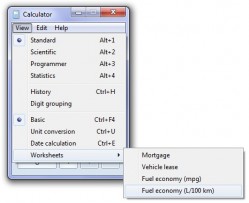
Think the Windows 7 calculator is something you’ll find yourself or your kids using now that you know it offers more features than just your basic calculator? What hidden or not-so-obvious features of Windows 7 have you discovered?

ISO:
A file that is created from an image of a CD. You can make an iso yourself with a program such as Adaptec Easy CD Creator, or you can burn an ISO file to a CD-R to create a copy of a CD.
Bin/cue files:
These are also used to create an image of a CD. Most people burn these with CdrWin or Fireburner. The .bin file contains all the data for the cd, the .cue file is just a small file in text format telling the software exactly how to burn the data onto the CD.
MP3:
Don’t know what these are? What cave have you been you living in? This is a format used to compress music files. You can create your own by encoding .wav files ripped from audio CDs.
Ace files:
These are used to compress/archive data. Use WinAce to decompress them, or to make your own. The normal format for ace files is to have .ace, .c01, .c01, etc.
Rar files:
Another compression/archive format. This is most commonly used on iso or bin files in order to split them up into smaller files (15 MB is the norm). Winrar and many other utilities can decompress these. Rar files are usually in the format .rar, .r01, .r02, etc. But don’t be surprised if you don’t see a .rar file. Just open up winrar and point it to .r01. You also may see them packed as .001, .002, etc. (maybe with a .rar, maybe not)
Pub:
This is an FTP that has left on anonymous access. Many are owned by large companies, so they have a lot of bandwidth. This makes it possible for one person to send files there and many people can download them at once =) These are found by scanning ranges of ips . Just remember, like the name says, these are public. Just because you upload something there or make directories with your name does not make it ‘your pub’. At the same time, realize that if you come across a pub with another person/groups stuff on it that it may be in use to build other pubs from – so don’t ruin it for many people by deleting stuff you find there. For more on this, go read some posts on our Bulletin Board.
Proxy:
A system that is set up to forward packets… There are many different kinds, check out the proxy tutorial for more info. Basically, a proxy server helps cover up your tracks because you connect to remote computers through the proxy. Think of it as the ************ of the Internet
SFV Files/ CRC Checks:
SFV files contain information about files that they accompany. You can preform a CRC check on the files using a program such as WinSFV. This compares the information in the SFV file to the file itself. If the information doesn’t match, then the file was probably messed up in transfer somehow.. try downloading it again, from a different source if possible.
0-Day:
Latest software releases.
0-Sec:
Same as above, although the period of time between ripping a game or application and it appearing on a warez site is even shorter.
Ace File:
The first file in a series of compressed archives (the one you double click on to decompress all the files at once).
Active List:
Similar to a mailing list, but uses ICQ to send instant messages to subscribers.
Alpha:
Software receives this label when it is in the very early stages of development. Usually full of bugs, so don’t touch it with a barge pole.
Anti-Leech:
A system which uses cgi scripts to prevent people stealing links and then taking the credit for uploading the files.
Appz:
Short for applications. For example Flash 5 or Avast 4.8
ASF File:
The worst quality movie file format (still pretty good though), much smaller in size than dat or mpg.
Banner Site:
Password and username restricted FTP site. To get the correct login details you must click on several banners.
Beta:
An acronym for Business Software Alliance, an organisation who are responsible for enforcing anti-piracy litigation. Similar groups in charge of controlling software “theft” include the SIIA, SPA and ELSPA.
BSOD:
Many people read about BSODs on bulletin boards and think that they’re being insulted, but there is no need to get paranoid. It is actually an acronym for “Blue Screen Of Death”. These can occur for a multitude of reasons (old Bill likes to keep us guessing!) and are the bane of PC user’s lives.
Bulletin Board:
A virtual meeting place on the web similar to a chat room except that it isn’t in real time. One person leaves a message then others come along, read it and add a reply. Each new discussion is called a new topic or thread and has it’s own link. Whenever a new topic is created the older topics are pushed one place downwards in the list. When someone replies to an older topic it is brought back to the top of the list.
C?? File:
File extension that indicates that a file is part of an .ace or .rar series of compressed files.
Cgi Scripts:
These are referrers which are used in url抯. When you click on a link with a ?cgi reference you are directed to a sponsor抯 website or an anti-leech protected file.
Cookie:
A tiny text file (usually less than 1kb), which is stored on your hard drive when you visit a web site. These are used to remember who you are so that you can access members only areas on the site without having to type in a password every time or to retain your personalised settings so that they are available the next time you visit.
Courier:
Someone who is involved in the logistics of delivering new releases directly from the release groups themselves to FTP sites.
Crack:
A tiny executable file that is used to transform a shareware program into the full version. Also used to remove any copy protection from the main executable of games (this will already have been done in “ripped” warez games).
CRC Error:
These can occur when you try to decompress a file that has become corrupt during the downloading process, usually as a result of too much resuming.
Credits:
The amount of data you are permitted to download from a ratio site. The more credits you have the more software you are allowed to download.
DAP:
A quick way of referring to “Download Accelerator Plus”, a free download manager that claims to speed up file transfers by up to three hundred per cent. It works by making multiple connections to the same file and is paid for by revolving advertising banners.Also supports resume. **EDITOR’S PICK**
DAT File:
File format used for movies, identical in quality and size to mpg as far as I can tell.
DC:
The lazy way of referring to the Dreamcast, Sega’s latest console incarnation.
Decompression:
Unpacking many files that have been stored in a single archive.
Distro:
A concise means of referring to a distribution FTP site. These are huge storage areas which act as a springboard for the transfer of new releases. Their whereabouts are never public disclosed to aid their survival rate. You can think of them as the initial source from which warez emanates.
Direct Downloads
Links to actual files rather than other warez sites or pages. These are usually gathered together from many different sites and put on one page for your convenience.
DivX:
Movies ripped from a DVD using the DivX video codecs. Can be played back using Media Player.
DIZ File:
Short for description. Very brief text file found in warez archives stating the title of the software, the number of files that makes up the set and the group who released it.
Download (or DL):
Copying files from a web server or FTP site to your computer using a modem.
Emulator:
An application that simulates another computer system or console using your PC.
FAQ:
Stands for Frequently Asked Questions.
FAW:
Abbreviation for “Files Anywhere”, a popular, free web storage service.
File Transfer Protocol (FTP):
The method used to transfer files from one computer to another using a modem.
Flaming:
A general net term for “verbally” attacking someone. This can be done via email, bulletin board, chat room or any medium which involves communication across the web.
Freedrive:
Virtual hard drive storage area on the web. Free to join and anything and everything can be uploaded or downloaded.
Freeware:
Unrestricted software that is downloaded from the net and is completely free to use. Often paid for using advertising.
FTP Client / Browser:
A program used to access, upload and download data from FTP sites.
Fxp:
The art of transferring data from one Ftp site to another using the connection speed of the slower of the two computers.
Gamez:
Pretty self-explanatory this one.
Getright:
One of the best download managers available.
Gold:
A piece of software is said to have gone gold when the final version is complete and it is ready to ship to the public.
Gozilla:
Another excellent download manager.
Hacking:
Gaining access to a remote computer without the authorisation to do so. Usually for the purposes of stealing confidential information or the malicious destruction of data.
Hammering:
Repeatedly trying to access an FTP site using an FTP client or download manager.
HTTP:
Stands for “Hypertext Transfer Protocol”. The method you use to view a web page. Always comes before the address of a website in your Url bar.
ICQ:
Derives from the term “I Seek You” and is used for real time chat and transferring files over the internet.
IP Address:
A series of numbers separated by dots used to identify your computer on the Internet.
IRC:
Stands for “Instant Relay Chat”. Used for real time chat and transferring files over the Internet.
ISO:
An exact copy of an original CD, all the multimedia bits and pieces are uncut and therefore they are extremely large and awkward to download.
Java:
Html scripts used to add functionality to or bring web pages alive. These include animation (such as the title graphic on my main page), menus, chat rooms, buttons, pop ups and so on.
Key Generator [Keyegn]:
A tiny executable program that is capable of creating a serial number from a specified username. These are specific to particular applications or utilities, so a serial number created with one key generator will only work for the program for which the key generator was developed.
Lamer:
An annoying and overused general derogatory term used to insult/put down anyone and everything.
Leeching:
Downloading files without giving anything back in return or copying other people抯 links.
Mirror:
An exact copy of a web site that is stored on a different server. Using multiple locations for warez sites allows the site to be accessed using a different address if the main site is deleted.
Modchip:
Very common website sponsor found on warez sites. They don抰 mind their banners being used on illegal software sites because their products are one of the 揼rey areas?of the law. Modchips are small pieces of electronic circuitry which allow copied games to be played on your Playstation. If a Playstation has been fitted with a Modchip it is said to have been “chipped”.
MP3 File:
Compressed music file format. Average track size is between 3 and 4 meg compared to 40-ish meg in wav format.
MPG File:
The best quality and largest movie file format.
Multi Web Space Faker:
A tool used to create lots of free web space accounts simultaneously.
Name Zero:
An organisation that offers free website domain names. The main drawbacks are that you have to put up with a very bulky banner residing at the bottom of your page and the fact that you never actually own your chosen address.
NFO File:
Short for info or information. Basic text file containing all the important details relating to a particular release, such as number of files, release date, copy protection system, installation instructions etc.
Nuked:
A release is said to be nuked if it is completely unplayable. Usually when this happens another group re-releases the particular game, although fixes do sometimes follow on to rescue the game from trash can.
OEM:
An acronym for Original Equipment Manufacturer. OEM software products are repackaged versions of the full retail product. They are often re-branded to suit the needs of the particular vender and are much more reasonable priced because they lack excessive packaging and a hard copy of the manual.
OST:
Not strictly a warez term this one, but one that you are likely to come across while searching for MP3 music. It stands for original soundtrack (movie music).
Patch:
We all know games and applications aren’t perfect. When they are released we would hope that they have been thoroughly tested for bugs and incompatibility problems, but you can guarantee that many of these will still slip through the quality control net. Once the program is released to the general public, the bug reports start to flood in. A patch is a downloadable executive file which takes these reports into account and attempts to incorporate all the fixes for these known problems. A patch can resolve incompatibility problems, prevent crashes or improve the performance of a piece of software.
Piracy:
The replication and distribution of videos or computer software.
Pop-ups:
Irritating browser windows that open automatically when you visit a warez site. Usually contain voting portals or porn sites.
Port:
A port is a term used when referring to FTP sites and is an essential extension of the address used to access them. If the port number of an FTP site isn’t specified the default setting of 21 will automatically be used.
Pron:
A long time ago in a galaxy far, far away someone posted a request for porn on a bulletin board, only, because of a typing error what he ended up asking for was “pron”. Since then this has become a bit of a running joke and so it is now deliberately misspelled.
Proxy:
A third party server which acts as an anonymous go between whenever you request a web page or contact a remote server. The message from your computer is first sent through the proxy server before being relayed to the final destination so that it appears as though the request has come from the IP address of the proxy server rather than you. Used when you wish to maintain your privacy on the net or speed up your connection (much more detailed info on this subject in the “more tips” section).
Psx:
A quick way of referring to the Sony Playstation.
Pub:
A free for all FTP site where anonymous access is permitted.
Pub Scanner:
Someone who scours the net for anonymous access FTP sites which permit the creation and deletion of files. These are then exploited by uploading software for others to share.
Pub Stealer:
Someone who posts the IP address of a public FTP site which they themselves have not built. Some pub stealers justify this by claiming that the elitism of private FXP groups discriminates against those people who do not have access, yet others simply post other people’s work to try to claim the credit for themselves. Either way though, pub stealers are despised by the FXP groups and praised by those who would otherwise not have access to them.
Rar File:
The first file in a series of compressed archives (the one you double click on to decompress all the files at once). Usually decompressed using a program called Winrar.
Release Groups:
A group of people who are involved in cracking and / or ripping software and then repackaging it into easily downloadable segments.
Ratio:
Two numbers separated by a semi-colon. Indicates how much data you must upload to an FTP site before you are permitted to download anything.
Reg File:
Tiny file that adds essential configuration details into the registry.
Resume:
The ability to stop and start downloading / uploading a file whenever you choose without having to start from the beginning again.
Rip:
Software that has had all the non-essential gubbins removed to reduce its size. Videos and music are always the first casualties.
Raped:
A release is branded with this term if it has been damaged beyond repair during the ripping process.
RM File:
Shorthand for Real Media, a file format used to encode video sequences, which can only be played back using the “Real Player”. Video clips produced using this format are not of the highest quality, but do have the advantage of a small file size.
ROM:
Games which are designed for other platforms, but are played on the PC using an emulator.
Serial:
A valid username and password that is saved as a basic text file and is used to register a shareware program and therefore remove all the restrictions.
Shareware:
Try before you buy software downloaded from the net.
Spam:
Unsolicited junk e-mail. Supposedly stands for “Stupid Person’s Annoying Message”.
Sponsor:
To make some money webmasters can place adverts on their sites. Each time you click on these adverts or banners they get paid a few cents for bringing potential customers to the sponsors website.
Surfer Friendly (SF):
Surfer friendly sites supposedly have no blind links, pop-ups or porn banners. Don’t be fooled by this label though as some sites will tell you fibs to get you to visit them.
Sys Op:
The person who has the responsibility for running the computer from which an FTP site has been established. When warez is uploaded to public FTP sites and then suddenly goes “Missing In Action” you can often lay the blame at the door of the Sys Op who has an obligation to make sure his/her server stays within the boundaries of the law (i.e. warez free).
Top List:
Chart which lists in rank order the best warez sites. Worked out on the basis of votes.
Trading:
Swapping warez, file for file via FTP, ICQ etc. Not usually approved of by the real warez community who believe that warez should be freely distributed. To put it simply, it is not the “warez way”.
Trainer:
A small, executable program which sits in your taskbar while you play a game. Hotkeys are associated with cheat commands so that when they are pressed you are given extra ammo, weapons, lives or the ability to toggle between invincible/mortal modes etc etc.
Trojans:
Nasty virus like attachments which can be merged with executable files. These are tiny so are unlikely to arouse suspicion. When run they allow a hacker to access your computer and wreak havoc. Can occasionally be found in warez files.
UBB:
Shorthand for Ultimate Bulletin Board, currently the most popular script used for creating warez bulletin boards.
UBB Hacks:
This term falsely gives the impression that something destructive or malicious is involved, but when you hear people talking about a hack in the context of bulletin boards they are simply referring to code which helps to improve the functionality of a board. For example a “thread hack” would effect the way in which individual threads look and operate.
Undeletable Pub:
An anonymous access, public FTP site where the permission attributes are set to allow uploads and downloads, but do not permit deletion.
Unzip:
Unpacking or decompressing many files that have been stored in a single archive. Technically only used when talking about zip files.
Upload:
Copying files from your computer to a web server or FTP site using a modem.
URL:
Stands for “Uniform Resource Locator”. The web site address you type into your browser.
Voting:
Members of the warez scene are very keen to reach the number one slot of top lists such as Voodoo, Top 60 etc. and will therefore encourage you to vote for their site to improve their position and get the credit they deserve (or not as the case may be!).
Warez:
Full version software that is uploaded to the internet and is available for free download.
Warez Board:
Bulletin board used by the warez community to share links and discuss anything related to warez.
Winace:
Another utility used for decompressing all the common archive formats. Not great in my opinion. See below for a better one.
Winrar:
Utility used for decompressing .rar files and much more.
Winzip:
An essential tool used to decompress warez files.
Zip:
A common compression format used to store warez .

Ever had that urge to merge 2 video’s ? For example you converted your favorite DVD to AVI and every VOB is converted seperatly ? Well, then this might be helpfull for you; Merging the files…
For this we need VirtualDub by Avery Lee, you can it at the VirtualDub site. Download it and install it. For additional info take also a look at the VirtualDub page on this website.
Now the process is pretty straight forward.
You can only merge files to one file at a time. So if you have more than 2 files to merge then first merge file A and B.
Just for example purposes, let’s say we have these files A, B, C and D. And we would like to merge these to file ABCD.
Step 1. Merge file A and B, let’s call this merged file AB.
Step 2. Merge file AB and C, let’s call this ABC.
Finally merge ABC with file D.
Note: all files merged MUST to be of EXACTLY the same format !
1. open VirtualDub.
2. Select “File” – “Open video file…” (or just press CTRL+O) and select the first file you want to have for your merge (in our example: file A).
3. Select “Video” and click on “Direct Stream Copy“.
4. Select “File” – “Append video segment” -> if the file formats don’t match, VirtualDub will warn you.
5. Select “File” – “Save AVI” (or press F7)
6. If you have more than 2 files to merge, then select “File” – “Close video file” and repeat step 2 to 6 until you have merged all files.
Note: Simply useing the copy command (DOS or Windows Command Shell) will not work since the AVI header does not contain the proper timecode anymore. The mergefile will be bigger, but at the end of the first AVI the movie will halt.
What is Google Public DNS?Google Public DNS is a free, global Domain Name System (DNS) resolution service, that you can use as an alternative to your current DNS provider. To try it out:
If you decide to try Google Public DNS, your client programs will perform all DNS lookups using Google Public DNS. |
|
Why does DNS matter?The DNS protocol is an important part of the web’s infrastructure, serving as the Internet’s phone book: every time you visit a website, your computer performs a DNS lookup. Complex pages often require multiple DNS lookups before they start loading, so your computer may be performing hundreds of lookups a day. |
|
Why should you try Google Public DNS?By using Google Public DNS you can:
|
http://www.eset.eu/knowledge-base/settings-are-password-protected
PROBLEM:
When I try to access the settings, the program asks for a password. What should I do?
SOLUTION:
Such notification is displayed when the ESET NOD32 Antivirus (or ESET Smart Security) program settings are password-protected. The password serves as a protection against incidental or unauthorized changes. If you don’t know the password, ask the person who set it to give it to you – if it is a company network, ask your network administrator. In the event that you created the password and later forgot it, ESET has created an Unlock Utility to remove the administrative password and restore your access to the configuration settings. Please follow the instructions below to use the ESET Unlock Utility:
Program parameters should be unlocked now.