Category Archives: Windows 10

Switch Windows 10 License from KMS to MAK


First Make Sure your not having a OEM or Retail Version installed, before activate with a MAK Key

Run this command to find the Edition installed

slmgr -dli

License Type Description
Retail This when you buy a Full Packaged Product (FPP), commonly known as a “boxed copy”, of Windows from a retail merchant or purchases Windows online from the Microsoft Store. Product keys can be transferred to another PC.
OEM Product keys are issued by the original equipment manufacturer (OEM) and are not-for-resale and may not be transferred to another computer. They may, however, be transferred with the computer if the computer is transferred to new ownership. If the OEM PC came preinstalled with Windows 8 or Windows 10, then the product key will be embedded in the UEFI firmware chip.
Volume KMS Client and Volume MAK product keys, are volume license keys that are not-for-resale. They are issued by organizations for use on client computers associated in some way with the organization. Volume license keys may not be transferred with the computer if the computer changes ownership. This form of licensing typically applies for business, government and educational institutions, with prices for volume licensing varying depending on the type, quantity and applicable subscription-term. A volume license key (VLK) denotes the product key used when installing software licensed in bulk, which allows a single product key to be used for multiple installations. For example, the Windows Enterprise edition is activated with a volume license key.

Below are some commands that can be used to convert a Windows 7/8/10 machine from KMS licensing over to MAK by using a MAK key:

  1. Open an administrative command prompt (or run a remote psexec shell or remote PowerShell).
  2. Change directory to C:\Windows\System32
  3. Run the following command to uninstall the current product key on the system:
    cscript slmgr.vbs /upk
  4. Install the new MAK key using the following command:
    cscript slmgr.vbs /ipk TypeYourMAKkeyHereWith-
  5. Once the new key is installed, activate it using the following command:
    cscript slmgr.vbs /ato
  6. You can check the licensing status using the following command:
    cscript slmgr.vbs /dlv
Device manager shows disk is read only

The following steps will show you how to use Diskpart to look at these settings and also how to clear them.

1.       Open a command prompt, type in Diskpart and then press Enter.

2.       Run the command “List Disk” and press Enter.


3.       Decide which disk you want to look at and then run the command “Select Disk n” where n stands for the number you see from the previous command.  In this case, I am going to look at disk 2.


4.       To see the attributes of Disk 1 now that it is selected, run the command “attributes disk”.


As you can see, I had already set the disk to Read-only, so both the “Current Read-only State” and “Read-only” attributes are set to Yes.

5.       To clear the “Read-only” attribute, run the command “attributes disk clear readonly”.


As you can see, now the “Current Read-only State” and “Read-only” attributes are set to No and the disk is now writeable.  To exit Diskpart, just type the word “exit” and then press enter.

Hopefully this will help you understand these attributes and help you diagnose a read-only problem with your disk.

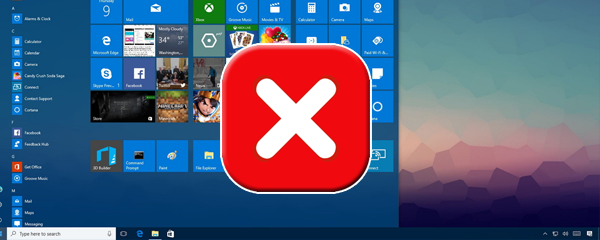
Windows 10 Start menu not working after joined to Domain

There may be many scenarios this could happen.  in this scenario you may be having a Windows 2008 R2 domain controller with this kind of group policy setting for registry (this is not a default group policy setting)


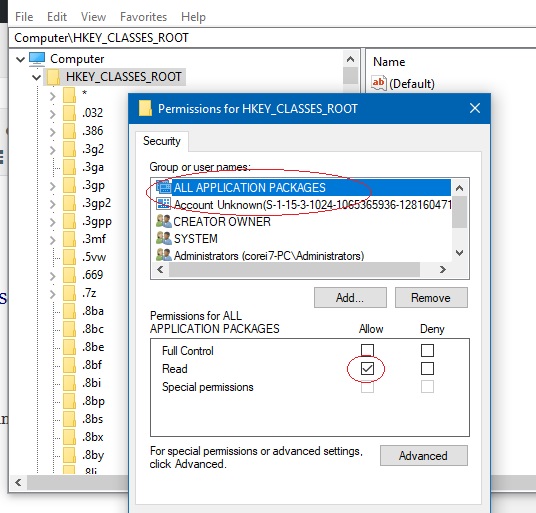
And These are the Default Permissions for this Registry Entry


The problem is For windows 10 “CLASSES_ROOT” need more permission to Access Windows Start menu settings

With Windows 2008 R2 Domain controllers this permission group is not available.If you need to add customized group policy settings for “CLASSES_ROOT” you need to have Windows 2012 R2 Domain controller or server 2016 domain Controller in your environment.


This is a screen shot from default settings for “CLASSES_ROOT” in Server 2016 Domain controller


What happen is When you modify that Registry entry with a Group policy in Windows 2008 R2 domain controller.Windows 10 Client PC will loss “ALL APPLICATION PACKAGES” FROM reading CLASSES_ROOT Registry permissions.

If your having only Windows 2008 R2 domain controller.

Delete This Group policy setting

Computer configuration > policies > Windows settings > Security Settings > registry > “CLASSES_ROOT”

run “gpupdate /force” on windows 10 Client PC

Login to Windows 10 PC As Domain Administrator

Go to Registry (Press Windows key + R and type regedit and press enter)

right click HKEY_CLASSES_ROOT And click permission and add “ALL APPLICATION PACKAGES” Group from LOCAL computer and give read only permission

Then click “Advanced” Button and tick “Replace all child object permission entire with inheritable permission entries from the object” and click apply it might take some time to apply settings.click OK and close registry editor and reboot.

If you have  introduced a 2012 R2 or a Server 2016 Domain controller to the existing domain with 2008 R2 you can just edit the Group policy setting for CLASSES_ROOT From 2012 R2 Domain controller Group policy editor and edit CLASSES_ROOT and click on “Add” Button > click “Location” Button > Select “LOCAL COMPUTER NAME” and Click OK.

Click “Advanced” And click “Find” then Select “ALL APPLICATION PACKAGES” Group click OK Twice and give “Read only” permissions for “ALL APPLICATION PACKAGES” Group.Click OK to save. run a “gpupdate /force” on the client computer and reboot.

that’s it, hope this will help to fix start menu not working problem in windows 10 ,even if your not in a domain environment you can just check this registry entry for correct permissions.


Windows 10 1803 Remote Desktop (RDP) Auto login not working

You may Face a problem with RDP Auto login is not working for saved Remote Desktop connection After Upgraded to windows 10 build 1803

or you will get this error message “Remote computer: This could be due to CredSSP Encryption Oracle Remediation”

What you have to do is edit local group policy settings.and go to

(To open Group policy settings go to “Run” And type “gpedit.msc” and press enter)

Computer configuration > Administrative Templates > System > Credentials Delegation

Edit “Encryption Oracle Remediation” and click “Enable” and change value in “Protection Level” to “Vulnerable” close Group policy and run “gpupdate /force” at command prompt.

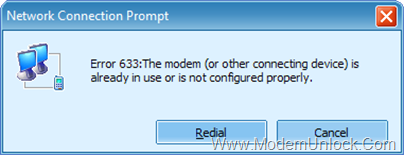
Error 633: The modem is already in use or not configured properly – Windows 10

Error-633_thumb

Question

Issue: How to Fix Modem Error 633 after Windows 10 Creators Update?

I’ve installed Windows 10 Creators Update yesterday. Apparently it broke my modem because it gives me the error message “Error 633: The modem is already in use or not configured properly.” It seems that the VPN connection cannot be established, but I actually don’t know how to fix that. Help, please!

Solved Answer

“Error 633: The modem is already in use or not configured properly” is the Internet connection issue, which has occurred for hundred of Windows 10 users after the installation of Creators Update. Microsoft has already acknowledged this issue and is working hard to release the solution the near future. However, before the future update patching the modem Error 633 is released, Windows 10 users have to perform the fixes manually.

The “Error 633: The modem is already in use or not configured properly” is not bound to one specific device, so any model and PC model can be affected. The error message explicitly indicates the fact that the modem is malfunctioning due to the faulty configuration. However, Error 633 may also occur due to the multiple Internet connections set up on one device or communication port exploited by another application. Luckily, Microsoft officially revealed the instructions that people should use before the patch for “Error 633: The modem is already in use or not configured properly” is released.

Run Registry Editor

  • Press Windows key, type regedit, and press Enter.
  • Navigate to HKEY_LOCAL_MACHINE\SYSTEM\CurrentControlSet\Services\RasMan directory.
  • Find RequiredPrivileges key and double-click it.
  • Add the SeLoadDriverPrivilege at the end of the list of keys and click OK.
  • If a warning message shows up, click OK to proceed.
  • Finally, reboot the system.

This worked for me 🙂  Credits to : – UGetFix

Windows 10 – Cannot start Virtual machine because the hypervisor is not running

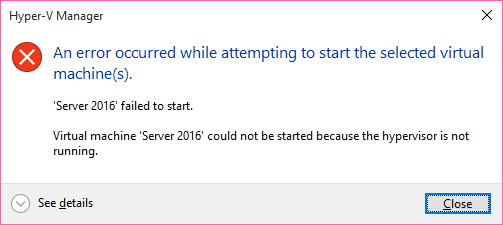
This post is just to fix if you cannot start a VM what was working previously perfect and suddenly it started to give Error

“Virtual machine [VM Name] could not be started because the hypervisor is not running”

2015-11-18-2

I suggested running the following from an elevated command prompt: (Please run Command prompt as administrator)

bcdedit /set hypervisorlaunchtype auto

Shutdown the Computer , Unplug the Power code and wait for a while and switch on the computer.

Now try to start the VM

Additional info –

WHAT is SLAT?

Second Level Address Translation is a technology introduced in both Intel and AMD flavors of processors. Both companies call their version of the technology different names, Intel’s version is called EPT(Extended Page Tables) and AMD calls theirs RVI (Rapid Virtualization Indexing). Intel introduced Extended Page Tables in its processors that were built on the Nehalem architecture, while AMD only introduced RVI in their third generation of Opteron processors codenamed Barcelona. Hyper-V uses this to perform more VM memory management functions and reduce the overhead of translating guest physical addresses to real physical addresses. By doing this, Hypervisor CPU time is significantly reduced, and more memory is saved for each VM.

How Do I Know If I Have SLAT?

Download Coreinfo from Microsoft Technet

[Mirror Download]

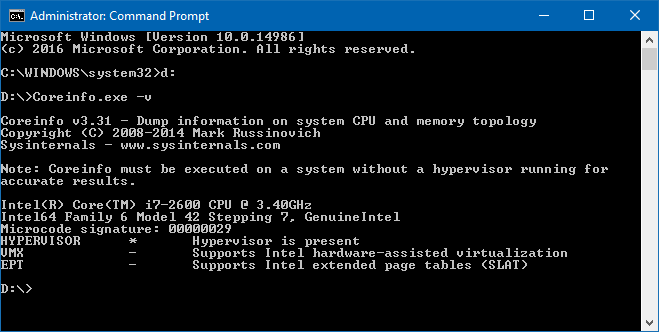
Run this command from a elevated command prompt

coreinfo.exe -v

if all ok it should be like this

2017-02-28


Update Windows Defender even when Automatic Windows Updates is disabled in Windows 8/10

Windows Defender will not update its definitions, if Windows Updates is not set to Install updates automatically in Windows 10/8. If for some reason you have changed your settings and preferred to set any of the other three updating’s options, viz. Download updates but let me choose whether to install them, Check for updates but let me choose whether to download and install them or Never check for updates, your Windows Defender will not have the latest definitions, till such a time that you update them manually. This is because, Windows Defender and Windows Update in Windows 8 are  both dependent on the Windows Updates services.

This is not a recommended scenario, as one’s security software should be updated as soon as new definitions are available for download.

Update Windows Defender when Automatic Windows Updates is disabled

But you can set it so that Windows Defender will check for, download and install updates as soon as they are available, even if you have disabled Automatic Windows Updates.

To do so, open the Task Scheduler. You will find it under Administrative Tools in your Control Panel.

task-scheduler-1

In the right pane, click on Create Basic Task. The Create Basic Task Wizard will open. Give the task a name and description and click on Next.

ts-2

Select the frequency, viz Daily.

ts-3

Set the Time at which the updating task should run.

ts-4

Next select Start a program.

ts-5

Advt

^

In the Program box, type “C:\Program Files\Windows Defender\MpCmdRun.exe”. MpCmdRun.exe is the executable file of Windows Defender that helps in carrying out common tasks like scanning, scheduling, updating, etc.

In the Add arguments box, type -SignatureUpdate. This is one of the available command line arguments for Windows Defender.

ts-6

Having done this, review the details and click on Finish.

ts-7

You will now be able to see the task in the Task Scheduler Library.

Now your Windows Defender will update itself, regularly, every day at the set time, although you may have disabled Automatic Windows Updates.

If you want Windows Defender to check for signature updates more than once every day, you will have to additionally do the following:

Open its Properties box and click on Triggers tab. Select the task and click on Edit.

def-props

Here check the Repeat task every and from the drop-down menu, select 1 hour. This will check for updates every hour. If you wish to check every 6 hours, simply change the figure from 1 to 6; it works!

edit-trigger

Click OK/Apply and Exit.

When the task is run, a black CMD window will open momentarily and close down.

If you wish to run a silent update, instead of: C:\Program Files\Windows Defender\MpCmdRun.exe –SignatureUpdate you may use: C:\Program Files\Windows Defender\MSASCui.exe -Update.

Let us know how this works for you.

(Credits to http://www.thewindowsclub.com/update-windows-defender-automatic-windows-updates-disabled )

Analyze and clean the WinSXS folder

Please note that the commands will only work on Windows 8 or newer machines.

Here is what you need to do to analyze the WinSXS Folder:

  1. Tap on the Windows-key, type cmd.exe, hold down Shift and Ctrl, and hit the enter key on the keyboard. This opens an elevated command prompt on the system.
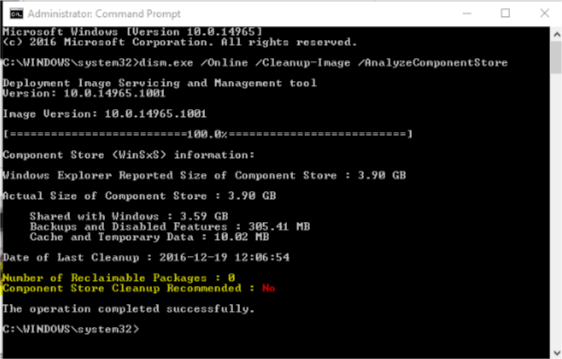
  2. Run the command dism.exe /Online /Cleanup-Image /AnalyzeComponentStore
  3. ceanup

The parameter /Online refers to the current installation, and /Cleanup-Image /AnaylzeComponentStore to analyzing the current component store of that installation (the WinSXS folder).


You can list all available commands using dism.exe /?, and subsequently dism.exe /Online /? and dism.exe /Online /Cleanup-Image /?.

The command runs a scan that takes a moment to complete. It echoes the Windows Explorer size and actual size to the command prompt window, and gives recommendations whether it makes sense to run a cleanup operation.

Cleanup

Windows runs a cleanup regularly using the Task Scheduler. You can check if that is the case on your machine in the following way:

  1. Tap on the Windows-key, type Task Scheduler and hit enter.
  2. Navigate to Task Scheduler (local) > Task Scheduler Library > Microsoft > Windows > Servicing > StartComponentCleanup

You can run the cleanup operation manually at any time using the following command using an elevated command prompt:

dism.exe /Online /Cleanup-Image /StartComponentCleanup

or for more

dism.exe /Online /Cleanup-Image /StartComponentCleanup /ResetBase


For service pack cleanup

dism.exe /Online /Cleanup-Image /spsuperseded /hidesp


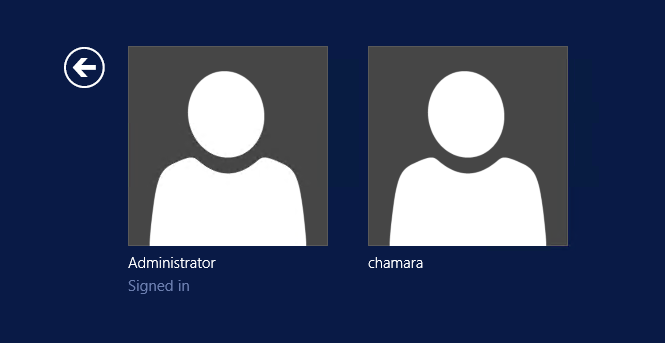
Windows 10 Edge can’t be opened using the built-in administrator account

edge_admin1a

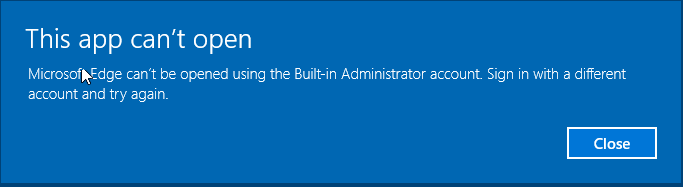
error Microsoft Edge can’t be opened using the Built-in Administrator account.  Sign in with a different account and try again.

In order to get around this message in your test environment and be able to use your Built-in Administrator account to navigate Edge, follow the following steps to get up and running.

  • Navigate to your local security policy on your Windows 10 workstation – You can do this by typing secpol.msc at a search/run/command prompt.
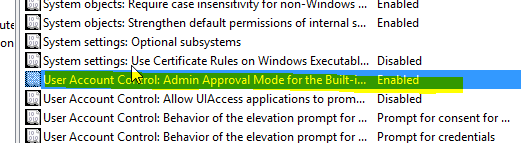
  • Under Local Policies/Security Options navigate to “User Account Control Admin Approval Mode for the Built-in Administrator account
  • Set the policy to Enabled

edge_admin1


***Updated for Windows 10 Home Users***

For Windows 10 Home users, the local security policy editor doesn’t exist.  However, most of the policy changes that can be made using the policy editor can also be made using the registry.  I have not tested this on a Windows 10 Home system, however, changing this registry key should be the equivalent to enabling the policy above – See the UAC registry guide from Microsoft https://technet.microsoft.com/en-us/library/Dd835564(v=WS.10).aspx#BKMK_BuiltInAdmin.  Navigate to the following registry key:

HKEY_LOCAL_MACHINE\SOFTWARE\Microsoft\Windows\CurrentVersion\Policies\System

  • Create a DWORD value if it doesn’t already exist called FilterAdministratorToken
  • Set the value to 1

Next we need to navigate to the registry and make an additional change:

  • HKEY_LOCAL_MACHINE\SOFTWARE\Microsoft\Windows\CurrentVersion\Policies\System\UIPI\
  • Change the Default string key to 0x00000001(1)Also, in addition to the above, make sure your User Account Control Setting is set to the third level from the bottom.  To get to UAC, go to your Windows 10 search and type uac.  It should come up as “Change User Account Control Settings“.

Finally, restart Windows and then you will be able to enjoy Edge under your Built-in Administrator account.